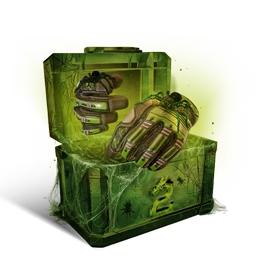
Unveiling the Thrills: The Excitement of CSGO Case Opening Revealed

September 24, 2026
The Ultimate Guide to CS:GO (CS2) Cases: Mechanics, Odds, and Economics
Since their introduction in the 2013 “Arms Deal” update, weapon cases have been a defining feature of Valve’s premier tactical shooter. Even with the game’s evolution into Counter-Strike 2 (CS2), weapon cases remain a massive part of the community experience. For many, opening cases is a thrilling pastime; for others, it is a complex virtual economy.
This comprehensive guide explores how CS:GO/CS2 cases work, the math behind the drops, the financial ecosystem surrounding them, and whether opening them is truly worth the risk.
What Are CS:GO Cases?
Weapon cases are virtual containers holding weapon skins, gloves, or knives. To open a case, a player needs two things:
- A Case: Earned as random drops through weekly gameplay or purchased from the Steam Community Market.
- A Key: Purchased directly from the in-game store for £2.50 GBP (or regional equivalent).
Once a key is used on a case, a roulette-style animation plays, eventually landing on a specific item dictated entirely by server-side probability algorithms.
The Mathematics of Case Openings: Rarity Tiers
Every time a case is opened, the game determines the item’s tier based on strict, predefined drop rates. While Valve does not officially publish the exact decimal percentages for every single item, extensive community data mining and millions of recorded openings have revealed the approximate probabilities.
| Rarity Tier | Approximate Drop Rate | Description |
|---|---|---|
| Mil-Spec (Blue) | ~79.92% | The most common, standard-grade weapon finishes. |
| Restricted (Purple) | ~15.98% | Uncommon skins, often with distinct patterns or colors. |
| Classified (Pink) | ~3.20% | Rare and visually striking weapon skins. |
| Covert (Red) | ~0.64% | The highest standard tier; highly sought-after, premium weapon skins. |
| Special Item (Gold) | ~0.26% | Ultra-rare knives or gloves. |
Note: There is also a distinct chance (roughly 1 in 10) that any dropped item will be in StatTrak™ condition, which tracks the number of kills made with that weapon.
Condition and Wear Values
Getting the desired skin is only half the battle. Every weapon dropped from a case is assigned a Float Value between 0.00 and 1.00, which determines its physical wear. This wear is categorized into five distinct float ranges:
- Factory New (FN): 0.00 – 0.07
- Minimal Wear (MW): 0.07 – 0.15
- Field-Tested (FT): 0.15 – 0.38
- Well-Worn (WW): 0.38 – 0.44
- Battle-Scarred (BS): 0.44 – 1.00
Some skins look pristine even in Field-Tested condition, while others look heavily battered. Generally, lower float values (especially close to 0.00) drastically increase a skin’s market value.
The Virtual Economy: Supply, Demand, and Investment
The CS:GO/CS2 skin economy operates much like a real-world stock market. Because cases are dropped less frequently over time—especially older cases moved to the “Rare Drop Pool”—their supply decreases while demand often increases.
Why Players Invest in Cases:
- Discontinuation: Once Valve stops dropping a case actively, its supply becomes finite.
- Inflation Hedge: Many players view rare cases as stable digital assets.
- The “Lottery” Factor: The excitement of unboxing a rare knife worth thousands of dollars drives continuous demand.
However, treating cases as investments carries risk. Valve holds the ultimate power to reintroduce old cases, alter drop rates, or change trade policies, which can drastically shift market prices overnight.
Tips for Navigating the Case Market
If players choose to interact with the case and skin ecosystem, keeping a few best practices in mind can prevent unnecessary financial losses:
- Set a Budget: Treat case openings strictly as entertainment expenses, not as a reliable way to make money.
- Buy Singles Instead: Statistically, buying the specific skin desired from the Steam Market or a trusted third-party site is almost always cheaper than trying to unbox it.
- Understand the House Edge: Just like a casino, the expected return on investment (ROI) for opening cases is significantly lower than 100%. Over time, the house (Valve) always wins.
- Beware of Scams: Never log into unverified third-party gambling or trading sites using Steam credentials, and be wary of API scam attempts.
Frequently Asked Questions (FAQ)
1. Are CS:GO cases still dropping in Counter-Strike 2?
Yes. The weekly drop system remains active in CS2. Players receive up to a couple of weapon drops and a case per week simply by leveling up their profile through active play.
2. Can I open cases without buying a key?
No. Every case requires a specific case key purchased from the in-game store (or traded via the Steam Community Market) to unlock.
3. What is the “Rare Drop Pool”?
When Valve introduces newer cases, older cases are pushed into the “Rare Drop Pool.” These cases drop extremely infrequently—estimated at roughly a 1% chance per case drop—causing their market prices to rise over time.
4. Are third-party case opening sites safe?
Most third-party gambling and case-opening websites operate outside of Valve’s direct control and often violate the Steam Subscriber Agreement. Using them carries a high risk of losing funds, and many are unregulated. Proceed with extreme caution.
5. Do skins affect gameplay?
No. All weapon skins, knives, and gloves are strictly cosmetic. They offer no competitive advantage, recoil reduction, or damage boost. They are purely for aesthetic customization and personal expression.
CS2Skin makes Case Opening simple and engaging—open virtual CS2 cases, explore skin outcomes, and enjoy clear, exciting results.